
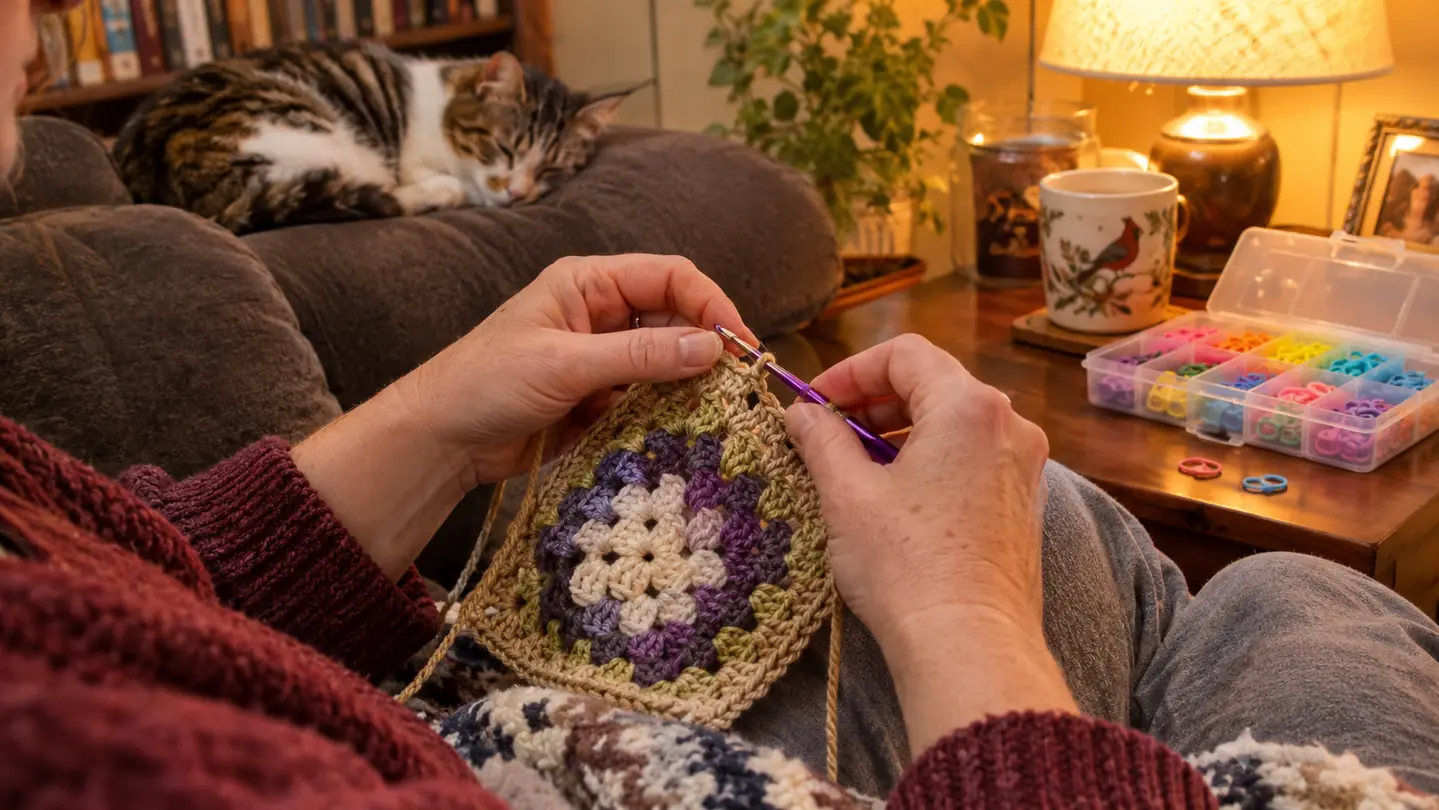
I have been crocheting since I was nine, and in all those years I have lost more stitch markers than I can count. Somewhere between the sofa cushions and the bottom of my project bag, they just disappear. So when I ordered the Meikeer locking stitch markers, I expected the usual little pouch of plastic clips that I would misplace by the second row. What actually arrived surprised me, and after six months of daily use, I have a few things to say that the product listing does not.
For context, I am Rosalind Brackett, a retired school librarian in Wichita Falls, Texas. I learned to crochet from my grandmother when I was a girl, and I picked it back up seriously about six years ago, after I retired. I make baby blankets, granny-square throws, dishcloths and amigurumi for my grandchildren, plus hats for a hospital charity drive. I also have mild arthritis in my right thumb, which means I notice right away when a tool is too heavy, too small or too awkward to manage.
The Quick Verdict
The markers are perfectly good. The case is the real win: 150 markers, sorted by color, that open with one snap even when my thumb is acting up.
Amazon Check Today's Price →The case is the part nobody talks about
Ten color-matched compartments, a latch that opens one-handed, and 150 markers so you never stop mid-row to hunt. Check today's price on Amazon.
Amazon Check Today's Price on Amazon →How I've Used It
I have used these markers almost every day for six months. My main projects in that time were a baby blanket in a shell stitch, a granny-square throw that I am still slowly assembling, a round of amigurumi animals for my grandchildren, and more hospital charity hats than I counted. The markers went through all of it, and they held up better than I expected a plastic marker to hold up.
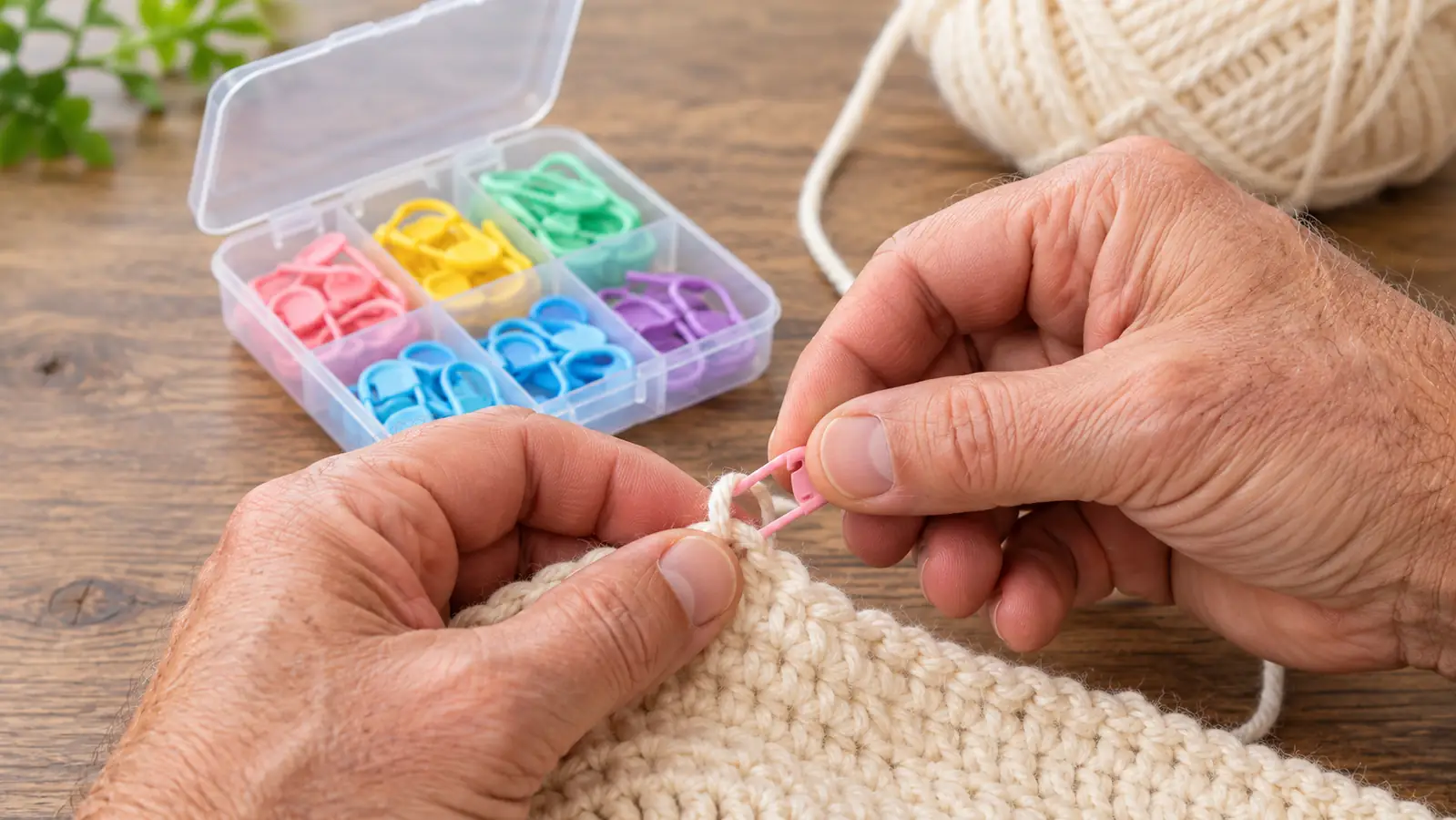
Each marker is small, 22 x 10 mm, about 0.86 x 0.4 inches, and rectangular. That size is enough to grab hold of comfortably, but not so big that it gets in the way of the yarn. I clip one at the start of a row, one at a repeat, and one wherever I need to remind myself that something changes two rows from now. The locking clasp stays shut. That matters, because a marker that falls off mid-row is a marker that costs you a mistake.
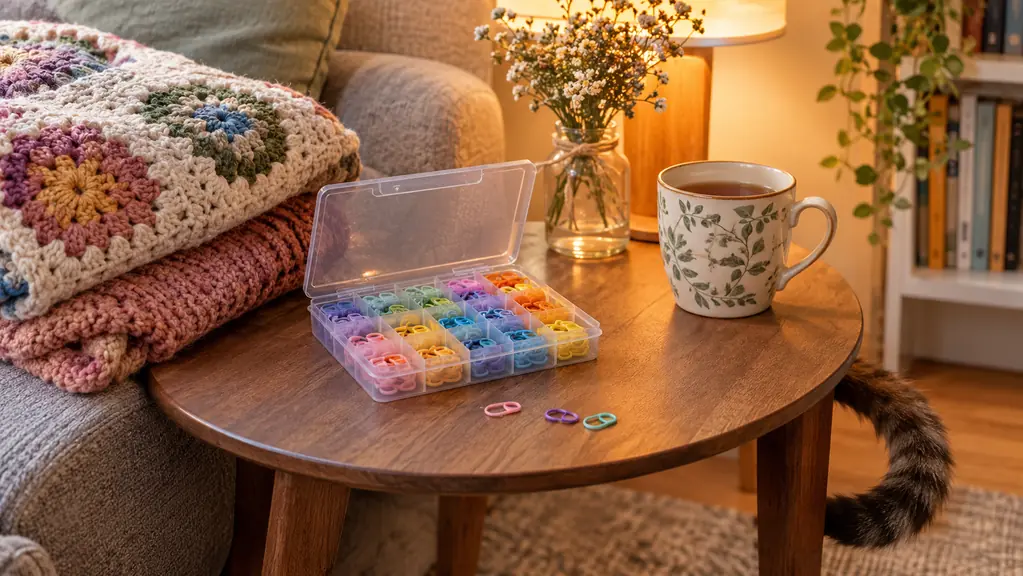
The part that genuinely surprised me is the case. It is a clear plastic box with ten compartments, each one color-matched to a shade of marker, and the latch snaps open with one hand. With my thumb, that is not a small thing. I have dropped plenty of notions over the years because they required two hands and a good grip. This one opens easily, and it closes with a satisfying click. Pickles, my cat, has batted at the box twice, and the latch has held both times.
I also use them when I crochet in the car, which I do when someone else is driving. A marker clipped at the end of the row means I can put the work down at a red light and pick it up again without counting. That alone has saved me more times than I can count.
What the Listing Does Not Tell You About the Case
The listing says the case is organized and hinged, and it says the latch opens with one hand. Both are true. What it does not say is how much of a difference that makes when your hands are tired. I crochet in a recliner in the den, with my yarn on a side table and a floor lamp over my shoulder. When I need a marker, I do not want to wrestle with a lid. This one opens with a snap, I take out the shade I need, and I close it again. It feels like the box was designed by someone who actually crochets.
The other thing the listing does not tell you is that the compartments are exactly the right size for the markers. Ten compartments, ten shades, fifteen markers per shade. The markers stay sorted, which sounds trivial until you are three hours into a blanket and you need the color you assigned to 'increase here.' You open the box and it is right there. I have had marker sets where everything lives in one bag, and I spend five minutes digging for the one I want. This is better.
One honest warning: if you drop the box, you will regret it. The latch is secure, but it is not a lock. I have not dropped mine, but I have knocked it off the side table once, and the lid popped open. Markers went everywhere. The silver lining is that they are small and light, so nothing broke, and the ten compartments meant I could gather them by color instead of sorting a pile of identical clips. Still, keep the box on a flat surface, and keep the cat away from it.
The Markers Themselves: Size, Grip, and the Plastic Question
Let me talk about the markers themselves, because the case gets the glory but the markers do the work. They are made of plastic, which is the thing I was most skeptical about. I have used metal markers for years, and I assumed plastic would feel cheap. It does not. The plastic is smooth, lightweight and flexible enough that it does not stretch or distort the yarn. For my arthritic thumb, the lightness is actually a benefit. A heavy marker on a fine yarn can pull the stitch out of shape. These do not.
The size, 22 x 10 mm, is a good middle ground. They are small enough to leave in the work without getting in the way, but large enough to find by feel when I am not looking. I have used markers that were so tiny I needed my reading glasses to pick them up. These I can manage by touch, which matters at the end of a long crochet session.
The locking mechanism is simple: a little arm that clips shut. It holds firmly on worsted weight yarn, and it holds on lighter yarns too, though on very fine thread I would probably reach for something smaller. I have not had one pop open on its own in six months. I have had plenty of cheap markers over the years that opened at the worst possible moment, usually two rows after I needed them. These stay put.
The other thing I noticed is how little pressure it takes to open the clasp. With some markers, my thumb protests after the tenth one. These open with a gentle squeeze, and the arm snaps back into place without fighting me. For anyone with arthritis, that is the difference between a tool you reach for and a tool you avoid.
Color Coding: What 10 Colors Actually Do for You
The Meikeer set comes with ten colors, fifteen of each. That is a lot of colors, and honestly, most projects do not need ten. But the ones that do are the ones where this set shines. On a granny-square blanket with a repeating pattern, I assign one color to the start of each round and another to the place where I need to switch yarns. On a shawl with increases, I use one color for the increase edge and another for the center spine. It turns the markers into a visual map of the pattern.
For a beginner, the color coding is even more useful. If you are learning to read a pattern and you keep losing your place, a marker in a bright shade at the start of every row is a lifeline. The listing says these work as stitch counters, row counters and round counters, and I agree. I have used them all three ways. The ten colors mean you can track more than one thing at a time without getting confused.
The honest downside: fifteen of each color is more than I will ever use. I have been crocheting daily for six months and I have not come close to using all 150. That is not a complaint, exactly. It means I will never run out, and I have started leaving a few in my project bags, my car, and the basket by my recliner. But if you are the kind of person who likes to own exactly what you need and nothing more, the sheer quantity might feel like clutter.
What Nobody Tells You
Here is the part that the reviews do not mention. The markers are small, and small things are easy to drop. I have dropped them on the carpet, on the hardwood, and once into a mug of tea. They survive all of it, but picking a 22 x 10 mm marker up off a carpet with arthritic fingers is its own small challenge. My trick is to keep a spare marker in my lap, and to keep the box on the side table where I can reach it without moving.
The other thing nobody tells you is that the clear box shows every speck of dust, cat hair and yarn fiber that lands on it. Pickles sheds, and the box is a magnet for orange tabby hair. It wipes clean easily, but if you are the kind of person who likes your notions to look pristine, you will be wiping this box regularly. It is a small thing, and it does not affect how the markers work, but it is real.
And one more: the plastic is not going to survive being chewed. If you have a dog, or a cat who thinks small plastic things are toys, keep the box closed and out of reach. Pickles has shown interest, but the latch has held. I would not test it. These markers are meant for yarn, not for pets.
How It Compares to What I Used Before
Before these, I used a mix of metal safety-pin style markers and cheap plastic ones that came in a little bag. The metal ones were sturdy but heavy, and on a lightweight yarn they pulled the stitches out of shape. The cheap plastic ones worked, but they were all the same color, so they were useless for tracking anything. The Meikeer markers solve both problems. They are light enough to leave in the work, and the ten colors mean I can track the start of a round, an increase, and a color change all at once.
I will be honest: I did not expect a box of plastic markers to change my routine. But the combination of the locking clasp and the color-matched case means I spend less time fiddling and more time crocheting. For a retired librarian who likes things organized, that is a small joy. I have already recommended them to two friends at my yarn circle, and one of them, who is left-handed and has worse arthritis than I do, had no trouble with the latch.
The only thing I miss from my old metal markers is the weight. There is something reassuring about a solid metal marker in your hand. But the lightness of these is worth the trade, and my thumb agrees.
What I Liked
- Snap-latch case opens with one hand, even with arthritis
- Ten color-matched compartments keep every shade sorted
- 150 markers means you will never hunt for one mid-row
- Lightweight plastic is easy on tired hands and does not stretch yarn
- Locking clasp holds through an entire project
Where It Falls Short
- 150 markers is far more than most projects need
- Tiny markers are fiddly to pick up off a carpet
- Plastic feels less sturdy than metal, even though it works fine
- The clear case shows dust and cat hair
- The latch is secure but not a lock; a drop sends markers everywhere
Six months in, I have not lost a single row to a marker that slipped, and I have not bought another stitch marker since.
Who This Is For
Buy these if you are a beginner who keeps losing your place in a pattern, or a confident crocheter who works on big projects with repeats and color changes. Buy them if you have arthritis or tired hands, because the lightweight plastic and the one-handed case make a real difference. Buy them if you are tired of digging through a bag of identical markers, because the color-matched compartments solve that problem completely.
I would also recommend them to anyone who crochets in more than one place, the way I do. Because there are so many markers, you can keep a few in your project bag, a few by your chair, and a few in the car, and still have plenty left in the box. For a charity crafter who makes hats and blankets in bulk, the quantity is genuinely useful.
I have also found them useful for charity hats. When I am making a stack of hats for the hospital drive, I clip a marker at the start of the decrease section, and I can pick up any hat in the pile and know exactly where I left off.
Who Should Skip It
Skip these if you only crochet occasionally and you already own a handful of markers that work fine. You do not need 150 of anything. Skip them if you prefer metal markers because you like the weight and the feel, because these are plastic and they will never feel like metal. And skip them if you work mostly with very fine thread, because a 22 x 10 mm marker is on the large side for delicate lace work.
Also, if you are buying these as a gift for a crocheter who is particular about their tools, I would ask first. Some people have strong feelings about plastic versus metal, and about how many markers they want in a box. The Meikeer markers themselves are good, but the person matters more than the product.
Six months later, they are still the markers I reach for
If you are tired of losing your place, losing your markers, or wrestling with a two-handed case, these are worth a look. Check today's price on Amazon.
Amazon Check Today's Price on Amazon →