
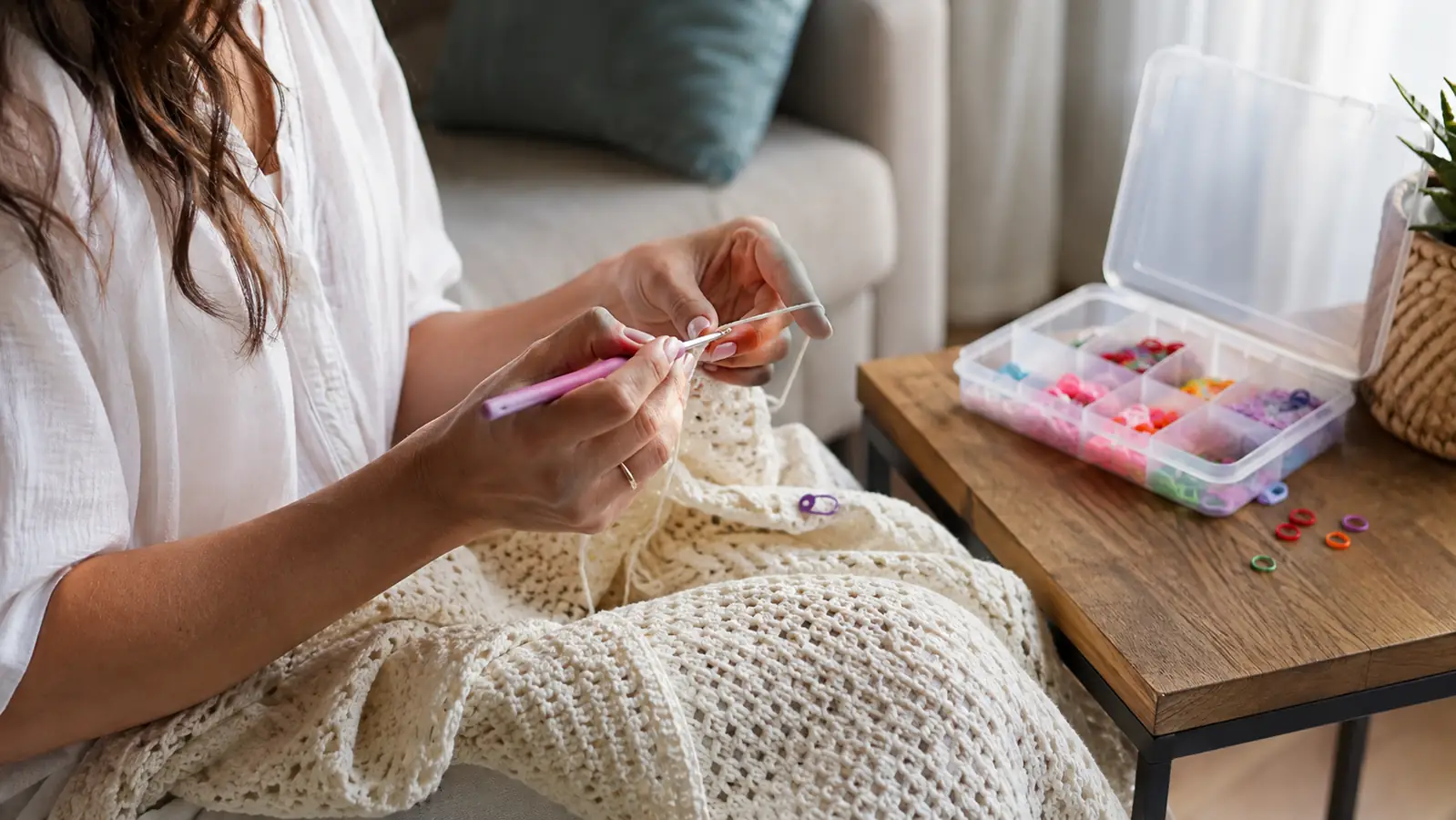
For years I marked my crochet stitches the way my grandmother taught me, with safety pins from the sewing basket. They worked, most of the time. Then in the first week of March I set them aside and switched to Meikeer locking stitch markers, and after six months of daily use, March through August, I can tell you exactly what held up and what did not. The short version is that I am not going back to safety pins for everyday crochet.
The Meikeer markers are easier on my hands, they stay put on every stitch I have tried, and the ten-color storage box is worth the switch on its own. Safety pins still have a place in my notion bag, mostly for the rare project where I need one marker and nothing fancy. But for blankets, throws, dishcloths, and amigurumi, the Meikeer set is the one I reach for every single time.
How I Compared Them
I did not do anything scientific. I crocheted the way I always do: baby blankets for the new grandbaby, granny-square throws, dishcloths, amigurumi for the older grandkids, and hats for the hospital charity drive. The first test was a shell-stitch baby blanket I started on the second Tuesday of March, and I marked the start of every shell repeat with a different color so I could see the pattern building as I went. By the end of the first week, I had already stopped reaching for the pins. I used the Meikeer markers on every project from March through August, and I kept a handful of safety pins in the same notion bag so I could compare them side by side. I paid attention to three things: how easily each marker opened, whether it stayed put when I set the project down, and how it felt after an hour of crocheting.
I also paid attention to the small annoyances, because small annoyances are what make a tool get left in the drawer. Which marker fell out when I stuffed the project in a bag? Which one was hard to find in the bottom of the notion bag? Which one made my right thumb ache, given the mild arthritis I have had for years? Those little things add up over a six-month stretch, and they tell you more than any spec sheet ever will.
| Meikeer Locking Markers | Safety Pin Markers | |
|---|---|---|
| Material | Lightweight plastic, warm in the hand, gentle on stiff fingers | Thin metal wire with a coated finish, cold to the touch |
| Grip and comfort | Rectangular 22 x 10 mm body opens with a light squeeze, easy to pinch even with arthritis | Narrow wire needs a firmer pinch to open and can dig into the thumb |
| Storage | Clear 10-compartment box with a snap latch that opens with one hand, every color sorted | Whatever jar or tin you keep them in, usually a tangle at the bottom |
| Color coding | Ten colors, 15 per shade, so you can color-code rows, repeats, and increases | One size, one finish, no way to tell one round from the next |
| Versatility | Locking clasp holds on any stitch, works as a row counter and round counter | Slips in and out easily, fine for a single mark but can slide out of loose stitches |
| Durability | Plastic can crack if you sit on one or step on it | Metal pins bend back into shape and last for decades |
| Best for | Color-coded patterns, amigurumi, and anyone with hand pain | Quick single marks and knitters who want something familiar |
Where Meikeer Wins
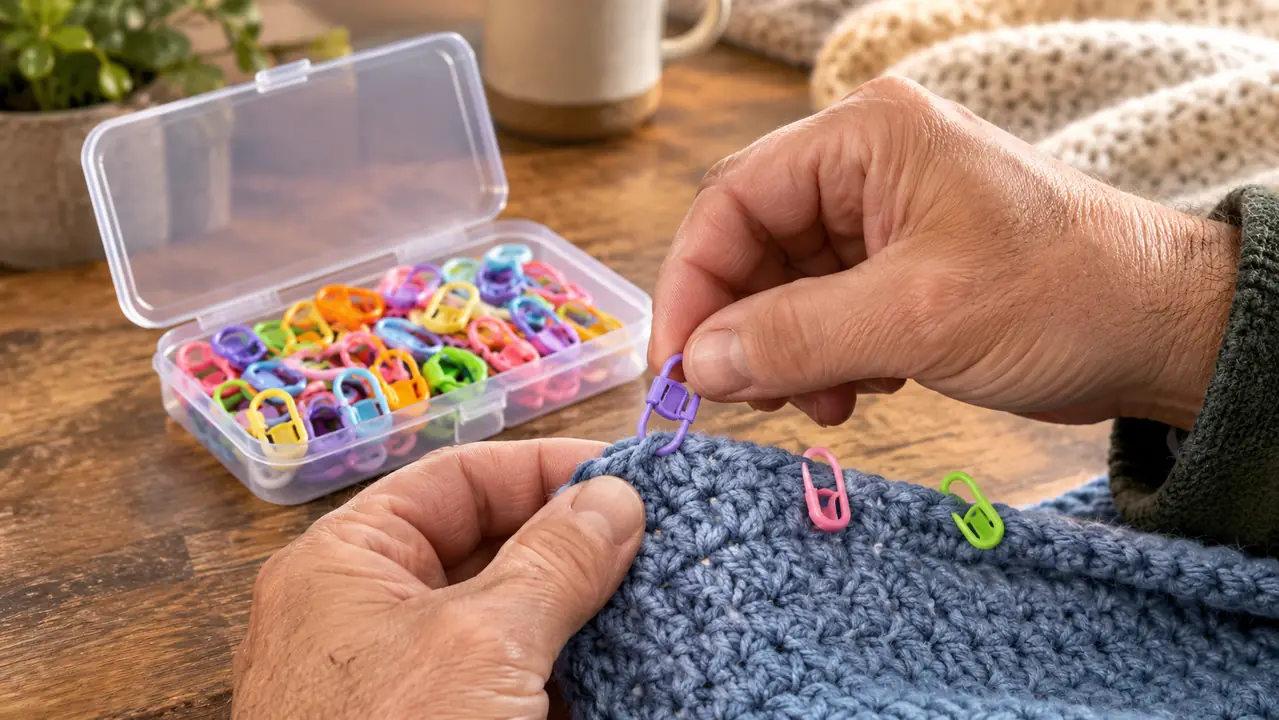
The biggest difference is the grip. My right thumb has mild arthritis, and opening a safety pin takes a firm pinch that gets old by the third repeat. The Meikeer markers are rectangular plastic, 22 by 10 millimeters, about the size of a dried bean. They open with a light squeeze, and the plastic stays warm in my hand instead of turning cold like metal wire. I can clip one onto a stitch without looking, which is exactly what I want when I am two hours into a granny-square throw and the light is starting to go. One evening in late April, I clipped a marker onto the start of a round while my eyes stayed on the television, and it landed exactly where I meant it to. I tried the same trick with a safety pin and missed the stitch entirely. That little experiment told me more than any spec sheet could about which tool belonged in my hand.
Then there is the color coding. Ten colors, fifteen markers per shade, and a clear storage box with a compartment for each one. I use one color for the start of a round, a second for increases, a third for a repeat I need to track. When a pattern says to repeat a section four times, I clip a marker in a fresh color at the start of each repeat, and I can see at a glance where I am. That alone has saved me from frogging more rows than I can count.
Where Safety Pin Markers Win
Safety pins are nearly indestructible. I still have pins from my grandmother's sewing basket that are older than I am, and they still open and close like the day she bought them. Plastic markers are not built for that kind of abuse. I have not cracked one yet, but I treat them more carefully than I ever treated a safety pin, and I would not want to sit on one. If you are hard on your tools, the metal pins have a real advantage.
There is also something to be said for a marker you do not have to think about. A safety pin costs nothing, lives in the sewing basket, and does the job when you need one marker for one stitch. If you only mark the occasional turning chain, the Meikeer set is more than you need. You would be buying 150 markers and using four. That is not a criticism of the Meikeer set. It is just honesty about what a light user actually needs. For a heavy user, the math works the other way.
The Meikeer markers open with a light squeeze, and the plastic stays warm in my hand instead of turning cold like metal wire.
Easier on your hands, easier on your count
The 150-piece Meikeer set gives you ten colors, a one-hand storage box, and a locking clasp that stays put through a whole project. It is the set I reached for every day from March through August.
Amazon Check Today's Price on Amazon →The Locking Clasp, Up Close
The locking clasp is the feature that sounds like marketing until you actually use it. A safety pin sits in a stitch and hopes to stay there. A locking marker closes over the stitch and holds on until you open it. I have dropped projects, stuffed them into a tote bag, and let Pickles bat at the yarn tail, and the Meikeer markers stayed exactly where I put them. A safety pin will usually stay too, but it can work its way out of a loose stitch, and once it does, your count is gone. The worst incident was a dishcloth in June. I packed it into a canvas bag with my library books, drove across town to the dentist, and when I pulled the cloth out in the waiting room, the safety pin was gone and the stitch had laddered down three rows. The Meikeer marker on the same project was still exactly where I left it.
The clasp is also easy to open one-handed, which matters more as you get older. I can pinch the two ends together with my left hand while my right hand holds the hook, and the marker opens right up. With a safety pin, I always seemed to need both hands and a free lap. It is a small difference, but when you place a marker every few rows, small differences add up to a much more comfortable afternoon.
The Storage Box Matters More Than You Think
I did not expect to care about the box. I expected to care about the markers, and I do. But the box is the reason I actually use all ten colors instead of grabbing the same shade every time. My safety pins lived in an old tin, and finding the right one meant dumping them all out on the table. The Meikeer box keeps every color in its own compartment, and the clear lid means I can see exactly what is where before I open it.
The snap latch opens with one hand, which matters when you are holding a project in the other. I keep the box on the side table next to my recliner, right beside the floor lamp, and I have never once had to hunt for a marker. Pickles has knocked the box off the table twice, and the latch held both times. That is the kind of detail you only learn from six months of daily use.
A Few Practical Notes
One thing worth knowing is that the markers are plastic, so they are light. Some crocheters prefer metal locking markers because they feel more solid. I tried a friend's metal set once and found it colder and heavier, and my thumb complained by the end of the evening. The Meikeer plastic markers are the opposite: light enough to forget you are holding one, warm to the touch, and easy to squeeze open. For my hands, that is the right trade.
The 150-piece count also means you can afford to lose a few. I have dropped markers into the couch, the car, and once into a bag of yarn that went to a charity drop-off. In May, one slipped between the seat cushion and the arm of my recliner while I was getting up to answer the phone, and I did not even bother to dig for it. I opened the box, pulled a spare from the same color compartment, and kept going. With safety pins, that would have meant a trip back to the sewing basket and twenty minutes of untangling the tin. With the Meikeer set, I have plenty of spares in every color, and the box makes it obvious when a shade is running low. That is a small thing, but it is the kind of small thing that keeps a project moving.
How the Colors Hold Up
The ten colors are the feature I did not expect to love. Fifteen markers per shade means I can dedicate a color to a specific job and still have plenty left. For a baby blanket with a repeating shell pattern, I used one color for the start of each shell and another for the increases. When I picked the project up the next day, I knew exactly where I was without counting a single stitch. That is worth more than any other feature on the set.
The colors are also easy to tell apart, even in low light. I crochet in the den under a floor lamp, and I have never once confused two shades. With safety pins, every marker looked the same, so color coding was never an option. That alone explains why the Meikeer box replaced my tin of pins within the first week.
What Six Months of Daily Use Taught Me
The first thing six months taught me is that locking markers are not a gimmick. The locking clasp actually holds. I have dropped projects, stuffed them in a bag, and let the cat bat at the yarn, and the markers stayed where I put them. The second thing is that the plastic is lighter than I expected, which is a blessing for my thumb. I can crochet for a full evening without the marker itself becoming the thing I notice.
The third thing is honesty about the material. These are not heirloom tools. They are lightweight plastic markers, and I would not toss them in a dryer or leave them where someone might sit on them. But for everyday crochet, they have held up fine through six months of daily use, and I have not had one break. The rectangular shape is comfortable to pinch, and the 22 by 10 millimeter size is big enough to find in a bag but small enough to stay out of the way.
Who Should Buy Which
Buy the Meikeer set if you crochet in the round, follow written patterns with repeats, or make amigurumi where one lost marker means a lost count. Buy safety pins if you mark one stitch per project and like the idea of a marker you can bend back into shape. Most of the crocheters I know, myself included, will be happier with the Meikeer set. The honest answer is that both have a place. The real test is how often you reach for a marker. I reached for the Meikeer box every single day from March through August, and that tells you everything.
The markers I used every day for six months
If you are tired of digging safety pins out of the carpet, the Meikeer locking stitch markers are a small change that makes a real difference. They are the ones I reach for now, and they are the ones I would buy again.
Amazon Check Today's Price on Amazon →