
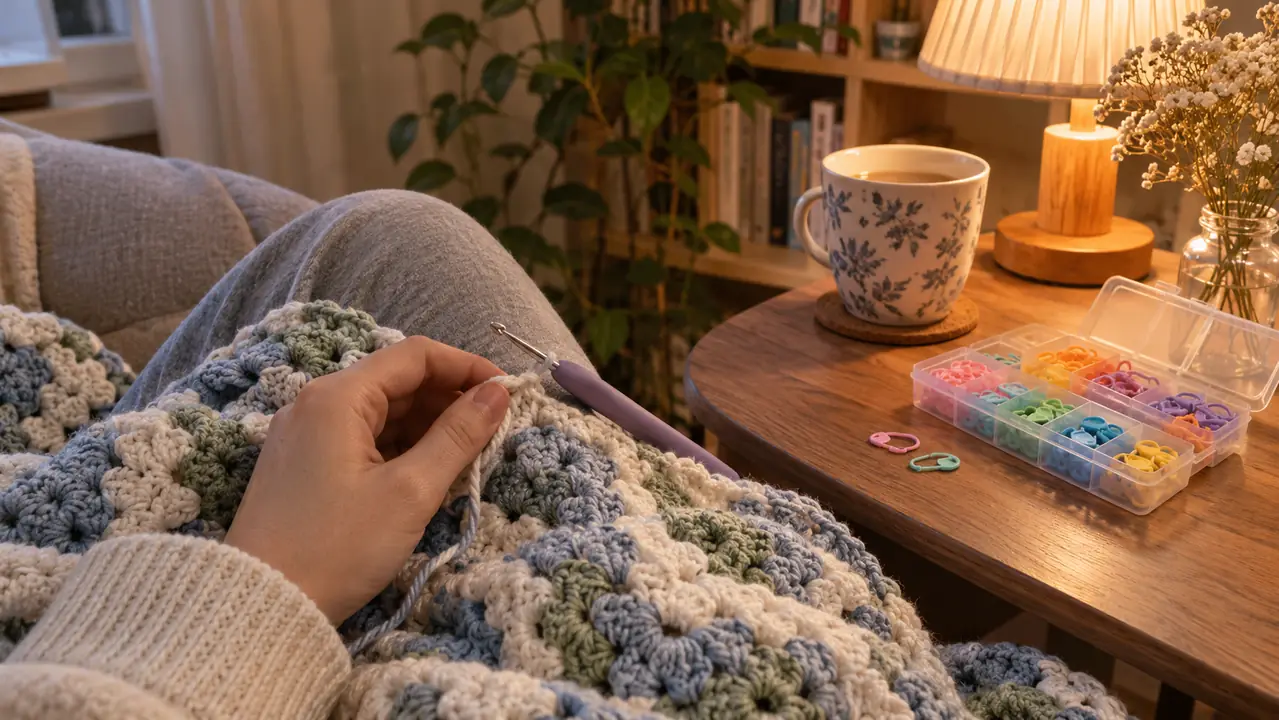
The box arrived on a Tuesday, and by Wednesday evening I had already lost one. That is not a criticism. It is the truth about me and small things, and Pickles, my 7-year-old orange tabby, does not help. He bats at anything that moves on the side table, and a 22-millimeter plastic marker looks exactly like a toy to him. Six months later, though, I am still reaching for the same Meikeer locking stitch markers every single night, which is more than I can say for the safety pins I used to dig out of the sewing basket.
I am Rosalind Brackett, 63, a retired school librarian in Wichita Falls, Texas. I have been crocheting since my grandmother taught me at age nine, and I picked it back up seriously about six years ago when I retired. I make baby blankets, granny-square throws, dishcloths and amigurumi for my grandchildren, plus hats for a local hospital charity drive. I also have mild arthritis in my right thumb, which means I notice every gram of weight in a tool. This is the long-term Meikeer review I wish I had found before I bought them.
The Quick Verdict
A 150-piece set that color-codes your rows, repeats and pattern changes for less than the price of a skein of good yarn. The plastic clips are light, smooth and easy on arthritic thumbs, and the hinged case keeps every shade sorted. They are not indestructible, and the smallest sizes can pop open if you pull them hard, but for daily blanket, dishcloth and amigurumi work, they earn their spot in my project bag.
Amazon Check Today's Price →Stop fishing safety pins out of the carpet
The Meikeer locking stitch markers come 150 to a box in 10 colors, with a compartment for every shade. That is enough to mark a whole blanket, a repeat, and the row you are on without borrowing from another project.
Amazon Check Today's Price on Amazon →How I've Used It
I crochet most evenings in a recliner in the den, with a floor lamp over my left shoulder and Pickles parked on the armrest watching my yarn tail like it owes him money. My projects over the last six months have been a granny-square throw, two baby blankets, a pile of dishcloths, and a small army of amigurumi animals for my grandchildren. That is a lot of rows, a lot of repeats, and a lot of places where one missed stitch turns a blanket into a trapezoid.
I used the Meikeer markers for three main jobs: marking the first and last stitch of a row so I do not accidentally drop or add a stitch, color-coding pattern repeats so I can glance at the work instead of counting in my head, and locking a live loop when I have to set a project down mid-round. The 22 x 10 mm size is small enough to sit out of the way on worsted weight or DK yarn, and large enough that my fingers find it without hunting.
I also did something I suspect most people do: I gave a few markers to a friend at our yarn circle, and I kept a handful in my purse for the times I crochet in the waiting room at the dentist. The markers that live in my purse are the ones that have been through the most, and they are the ones that tell me the most about how this set holds up.
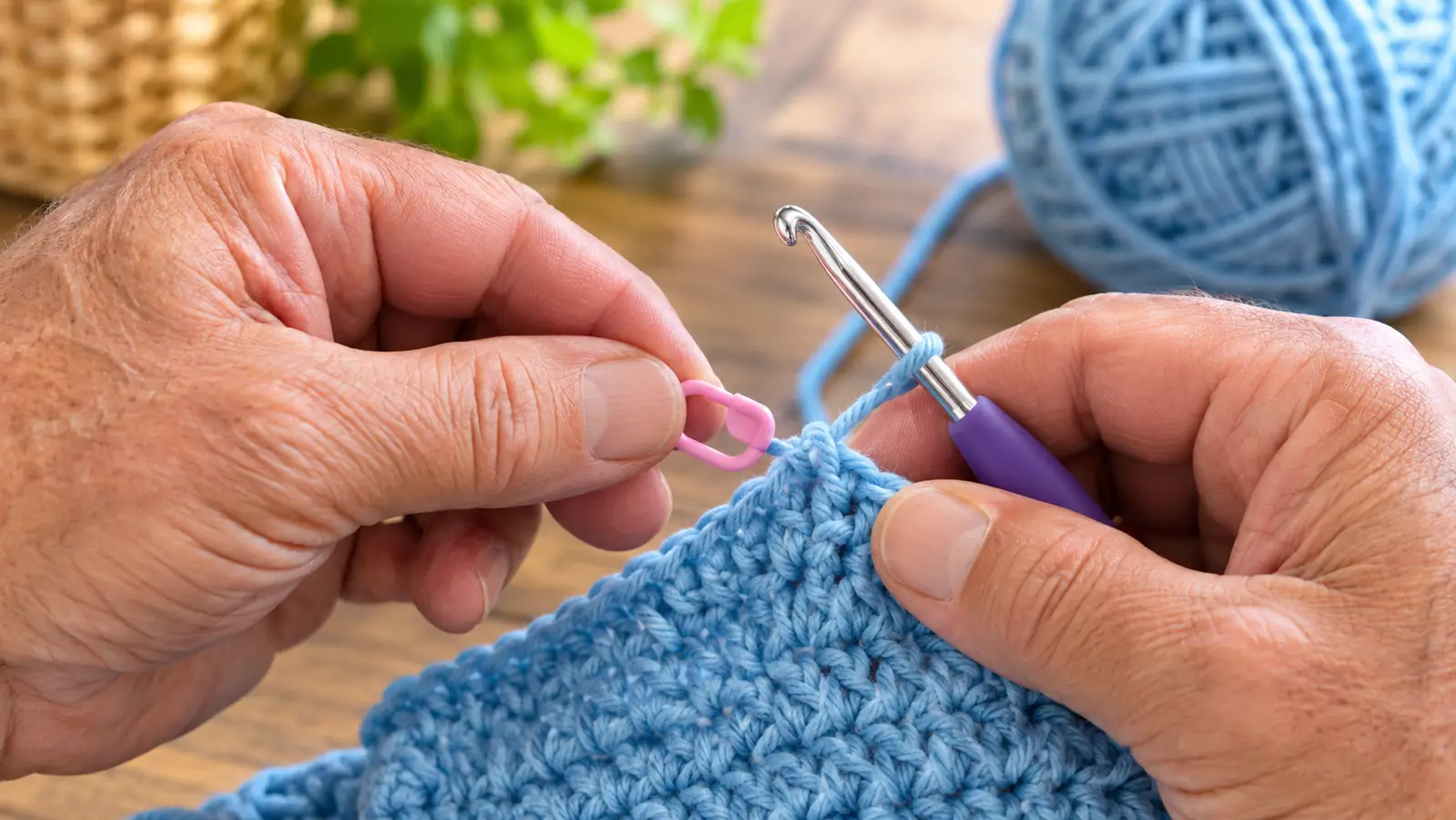
One project in particular put them through their paces. In late September I started a granny-square throw for my oldest granddaughter, a five-foot square with a four-round repeat in three shades of worsted weight. That meant marking the corner chains on every round, which is exactly the job a locking marker is made for. I clipped a marker at each corner, worked the round, moved the markers up, and never once had to count my way out of a corner. The throw took me about three weeks of evenings, and I used the same four markers the whole way through. They still snap shut today, and they are the ones I reach for first when I start something new.
What the 150-Piece Set Actually Gives You
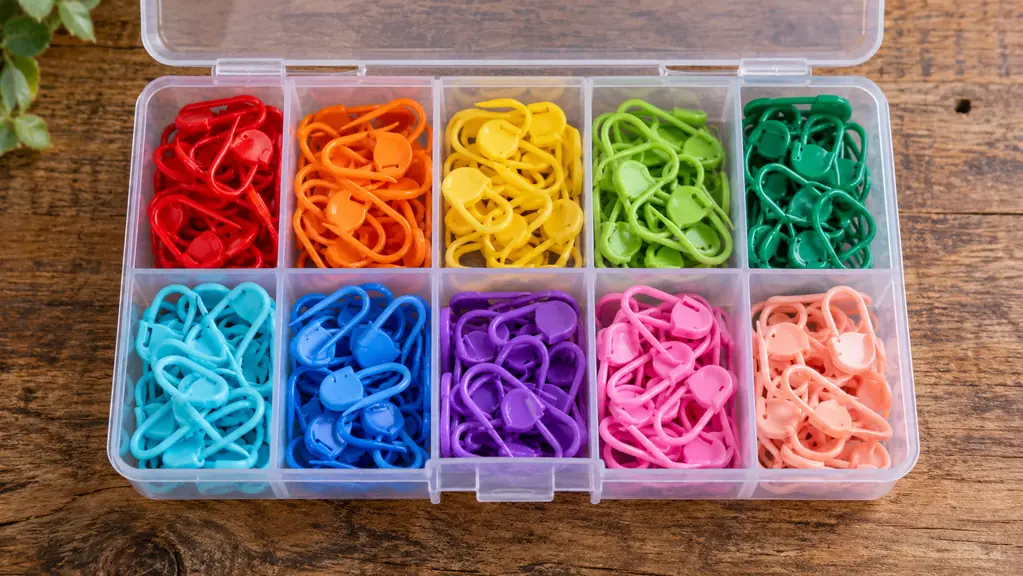
The headline number is 150 markers in 10 colors, which works out to 15 per shade. That sounds like a lot until you are working a blanket with a 12-row repeat and you want to mark every repeat boundary across the width. Then it feels exactly right. I keep one full set in the den, one smaller set in my travel bag, and I still have enough left over that I do not panic when one rolls under the couch.
The markers are plastic, rectangular, and measure 22 x 10 mm, or about 0.86 x 0.4 inches. They are light, which matters to me more than it used to. My arthritis means heavy metal markers make my hand ache by the end of the evening. These do not. The plastic is smooth, with no rough seam where the two halves meet, and the locking mechanism closes with a satisfying click.
The included clear storage box has ten compartments, one for each color, and the lid is hinged with a snap latch. I was skeptical about the latch at first, because cheap cases always break at the hinge. Six months in, mine still clicks shut, and the compartments still keep my shades sorted. That is the feature I did not expect to care about and now cannot live without. When I used safety pins, every project started with ten minutes of untangling. Now I open the case, pull one compartment, and go.
I counted them out the first night, which is the kind of thing a retired librarian does. Fifteen per shade, exactly as the listing says, and every one of the ten compartments was full. I set aside five markers in each of my two most-used colors as a travel stash, and the box still looked full. The compartments are sized so the markers lie flat instead of tangling, which is more than I can say for the old sewing tin where my safety pins lived. When I close the lid, the latch clicks, and Pickles has learned that the click means the fun is over. It was the first time a storage box made me want to keep it out on the side table instead of tucked away in a drawer.
How the Locking Mechanism Held Up Over Months
The locking mechanism is the whole point of a locking stitch marker, and it is the part I watched most closely. After six months, the vast majority of my Meikeer markers still snap shut firmly and stay shut while I work. I have had a few that feel looser than the rest, and a handful that pop open if I pull them hard across a thick yarn or a tight stitch. None have broken in half, and none have lost their grip entirely.
The honest tradeoff is that a locking marker is not a safety pin. It is not meant to be yanked. The right way to use it is to open the clip, place it around the stitch, and let it close. When I do that, even on the tightest stitches of a baby blanket, the marker stays put. When I try to force it over a thick join without opening it first, I am asking for trouble, and sometimes I get it.
One thing I learned the hard way: the 22 x 10 mm size that feels perfect on worsted weight can feel a little snug on bulky yarn. For bulky yarn, I open the marker fully and clip it around the stitch rather than trying to thread it through. It works, it just takes an extra second. The markers are also small enough that I have to be careful not to drop them on the carpet, especially when Pickles is watching.
The one time a marker let me down was my own fault, in a way. I was working a baby blanket in a tight shell stitch and tried to clip a marker over a join without opening it fully. The marker popped open, flew across the den, and Pickles was on it before it stopped rolling. I found it two days later under the bookshelf, none the worse for wear, and it has clipped shut fine ever since. That incident taught me the one rule I now follow: open the clip, place it, let it close. When I do that, even on the tightest stitches, the markers hold. The marker that flew across the den is still in rotation, which tells you more about the set than any claim I could make.
Color-Coding Rows Without Counting in Your Head
The ten colors are the feature I use most. For a granny-square throw with a four-round repeat, I assign one color to round one, another to round two, and so on. When I pick up the project after dinner, I can tell at a glance which round I am on, no counting, no magnifying glass, no frogging because I lost my place. For a baby blanket with a shell stitch repeat, I clip a marker at the start of each repeat so I can see the pattern marching across the row.
The colors are distinct enough that I have never confused two shades, even in the dim light of my den. That matters more than it sounds. I have used sets where two colors were so close that I had to hold them side by side to tell them apart. Not here. The ten shades read clearly, and the compartment box keeps them that way.
For amigurumi, the markers are my round counters. I work in a spiral, which means there is no visible seam to tell me where a round ends. A Meikeer marker in the first stitch of each round keeps me honest, and the light weight means it does not distort the work the way a heavy metal marker can. My grandchildren are too young to notice a slightly stretched stitch, but I would notice, and it would bother me.
The hospital charity drive gave me my favorite use for the colors. I make the same hat pattern over and over for the drive, a simple double crochet beanie, and I wanted a way to tell at a glance which size I was working. I assigned one color to the newborn size, another to the toddler size, and a third to the adult size. One marker clipped at the start of the round told me everything I needed when I picked a hat back up. I finished forty-two hats between October and December, and I never once had to count a round twice because I lost my place. The colors did the remembering for me.
What I Liked
- 150 markers in 10 colors, 15 per shade, enough to stock several projects at once
- Light plastic is easy on arthritic hands and does not distort stitches
- Hinged ten-compartment case keeps every shade sorted and opens one-handed
- Distinct colors that read clearly even in dim lamp light
- Locking clips stay put through rows of worsted and DK weight yarn
Where It Falls Short
- A few clips have loosened over six months and can pop open if forced over thick yarn
- The 22 x 10 mm size feels snug on bulky yarn
- Small enough to vanish in the carpet, especially if a cat is involved
Six months in, the box still clicks shut, the colors still sort themselves, and I still reach for the same Meikeer markers every single night. That is the whole review.
Who This Is For
This set is for the crocheter who works on more than one project at a time and is tired of losing her place. It is for the blanket maker who needs to mark a repeat across a wide row, the amigurumi maker who works in spirals, and the knitter who wants a row counter that does not require a separate gadget. It is for anyone with arthritis or hand fatigue who wants a marker light enough to forget it is there.
It is also for the person who, like me, loses small things. With 150 markers, losing one is an inconvenience, not a crisis. The compartment box means I can see at a glance which color is running low, and the one-handed snap latch means I can open it while holding a project in the other hand. For a beginner, the color-coding alone is worth the price, because it removes the most common frustration: losing your place and having to count every stitch again.
Who Should Skip It
If you work almost exclusively with bulky or super bulky yarn, the 22 x 10 mm size may feel small, and you may find yourself opening each marker fully to get it around the stitch. If you prefer the weight and feel of metal markers, or if you want a marker that can double as a cable needle, this plastic set is not that. And if you are the kind of crocheter who keeps one marker on one project and never loses it, a 150-piece box is more than you need, though the price makes it easy to justify anyway.
I would also gently suggest that if you have a cat like Pickles, you will want to keep the box closed. The markers are exactly the right size and weight to be batted under the couch, and the orange tabby in my house has retired several of them to the dust bunny colony. The good news is that with 150 in the box, I have not run out.
The markers I reach for every single night
After six months of daily use, the Meikeer locking stitch markers are still the first thing I grab from my project bag. Color-coded, light on arthritic hands, and organized in a case that actually holds up.
Amazon Check Today's Price on Amazon →