
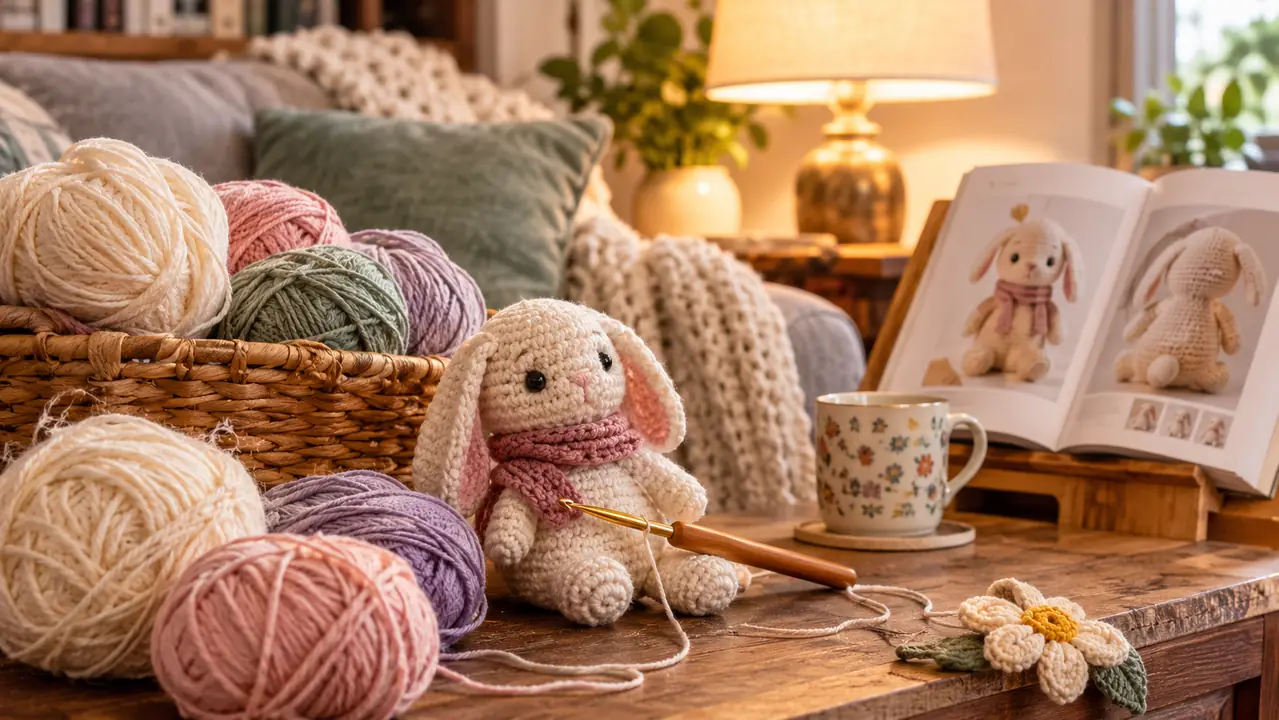
The first time I tried to crochet a little animal, I picked a free pattern from a blog and spent an hour fighting a magic ring that kept pulling loose. I am a retired school librarian in Wichita Falls, and I have crocheted for most of my life, but amigurumi is a different animal. Free patterns assume you already know things they never explain. Then a friend showed me Amigurumi Friends, a pattern book from Quarry Books, I bought my own copy, and I finally understood what I had been missing.
Amigurumi Friends lays out 20 easy patterns and shows how to combine shapes, colors, details, and yarns to make more than 100 custom critters. That is the part that won me over: one pattern, and suddenly I knew how to change it. The book is 144 pages, light enough to sit open on the arm of my recliner, and it has been the difference between patterns I struggle through and patterns I actually finish.
I started making critters for the same reason I started making blankets: grandchildren. There is something about handing a child a small animal that came off your own hook that no store-bought toy can match. My oldest granddaughter named my first critter Mr. Wobble, because he does not sit up straight, and she loves him anyway. That is the whole point.
Start with a book that explains the why
Amigurumi Friends gives you 20 easy patterns, 144 pages of plain-language instructions, and a method for turning one pattern into a dozen different critters. My copy has yarn fuzz in the spine and a cat hair or two between the pages.
Amazon Check Today's Price on Amazon →Why a Pattern Book Beats a Free Pattern for Your First Critter
Free patterns are wonderful once you know the basics, and I still use them for dishcloths and simple blankets. But for a first critter, you want something that explains the why, not just the what. A pattern book sits open beside you, stays put, and does not disappear when your tablet dies. That matters when your hands are full of yarn and your stitch marker just rolled under the chair.
I tried a single pattern download before I bought the book, and it was fine until it was not. The download had one photo, no explanation of why the stitches went where they did, and a typo in round four that I only caught because I had made enough blankets to be suspicious. A book has room for the why. That is worth something when you are learning a new shape.
The other thing a good book gives you is a system. Amigurumi Friends is built around the idea that you learn a few basic shapes and then mix and match. The patterns are all listed as easy, and the book walks you through shapes, colors, details, and yarns before you ever start a critter. I read that part the way I used to read a new library catalog: slowly, and with a pencil in my hand.
Step 1: Pick One Easy Pattern and Read It Twice
Do not start with the cutest pattern. Start with the simplest one, something with a round head and a round body, because you want to learn the method before you add ears, arms, and a tail. I chose a plain little creature and read the whole pattern before I picked up a hook. Reading it twice took ten minutes and saved me an evening of ripping out stitches.
Gather what the pattern calls for before you start. The book's yarn guidance explains how yarn weight changes the size of your finished critter, so read that before you buy anything. I used a soft worsted weight yarn and the hook size the yarn label recommended, and my critter came out about the size of my palm. If you want a bigger critter, go up a hook size and a yarn weight; the book explains that trade-off clearly.
Also, tell the cat. Pickles, my orange tabby, considers any loose yarn tail a personal invitation. I learned to tuck the working yarn into a zippered project bag between sessions, or I would spend the next morning untangling a magic ring from under the couch.
Step 2: Master the Magic Ring Before You Start Round One
Most amigurumi starts with a magic ring, a loop you tighten after the first round so there is no hole in the top of the head. It is the most important skill in this craft, and it is the one thing free patterns never explain well. The first two tries will look like a knot. That is normal. Pull the tail to close the loop, work your first round of single crochet into the ring, and tighten it again before you move on.
The magic ring is also where my arthritis made itself known. My right thumb complains when I hold a tiny loop tight for too long. What helped was keeping the ring loose until the first round was complete, then taking a break before I started the head. I also used the largest hook that still made a neat stitch, because small hooks are harder on my hands.
Count as you go. Every amigurumi pattern is a spiral of single crochet, and the only way to keep the head round is to know exactly where you are in the round. I put a stitch marker in the first stitch of every round and counted out loud. Counting out loud is the only way I keep a round straight, and I do it without shame.
Step 3: Work in Continuous Rounds and Trust the Spiral
Unlike a blanket, where you turn at the end of each row, amigurumi is worked in a continuous spiral. You never join the rounds; you just keep going around and around. That is why a stitch marker matters so much. If you joined the rounds, the seam would wander, and a wandering seam on a little animal face is not cute.
The patterns in Amigurumi Friends tell you exactly how many stitches belong in each round, and the numbers matter. If the pattern says round six is 30 single crochet and you have 29, do not keep going. Find the missing stitch before you finish the head, because the head is the one part you cannot hide. I learned this the hard way with a lopsided bunny that my granddaughter politely called a bunny with personality.
This is also the step where the book's shape guidance earns its keep. The same basic ball can become a head, a body, a paw, or an ear depending on where you increase and decrease. Once I understood that, I stopped following patterns like a recipe and started seeing the shape underneath. That is the moment amigurumi stops being mysterious.
Step 4: Stuff as You Go, Not All at Once
Stuffing is where beginners overdo it. A critter stuffed like a biscuit is stiff and lumpy, and the stitches stretch until you can see the stuffing through them. The trick is to stuff a little, shape it with your fingers, and add more only when the piece starts to feel hollow. The body should give a little when you squeeze it, like a firm marshmallow, not a baseball.
Amigurumi Friends walks you through details, and the details are what make a critter look finished. But the details come last. Stuff the head, close the opening, and set the piece aside while you make the body. If you try to do everything at once, you will have yarn tails everywhere and a cat who thinks you are making her a new toy.
I stuff with small pieces, not one big wad. It makes the critter softer and easier to shape, and it is kinder to my hands, because I am not wrestling a dense ball of fiber. My first critter has a slightly lumpy belly, and my granddaughter calls it his tummy, so I have decided it is a feature.
Step 5: Sew Parts Together With the Yarn Tails, Then Add the Face
The last step is the one that turns a pile of crocheted balls into an animal. Leave long tails when you finish each piece, because those tails are your sewing thread. The book's detail guidance shows how to place ears and arms so the critter looks like the picture, and that is where I needed the most patience.
Pin the parts on before you sew. I used bobby pins from my granddaughter's barrette collection, because I did not have actual pins, and I do not recommend that. Even with pins, I sewed the first ear on, looked at it, and immediately took it out. Taking a seam out is not failure; it is how you learn where the ear belongs.
The face comes last, and the book's detail guidance gives you options for eyes and mouths. I embroidered simple eyes with black yarn instead of using safety eyes, partly because I was making this for a small child and partly because safety eyes are another thing for Pickles to knock under the couch.
What I Wish I Had Known Before My First Critter
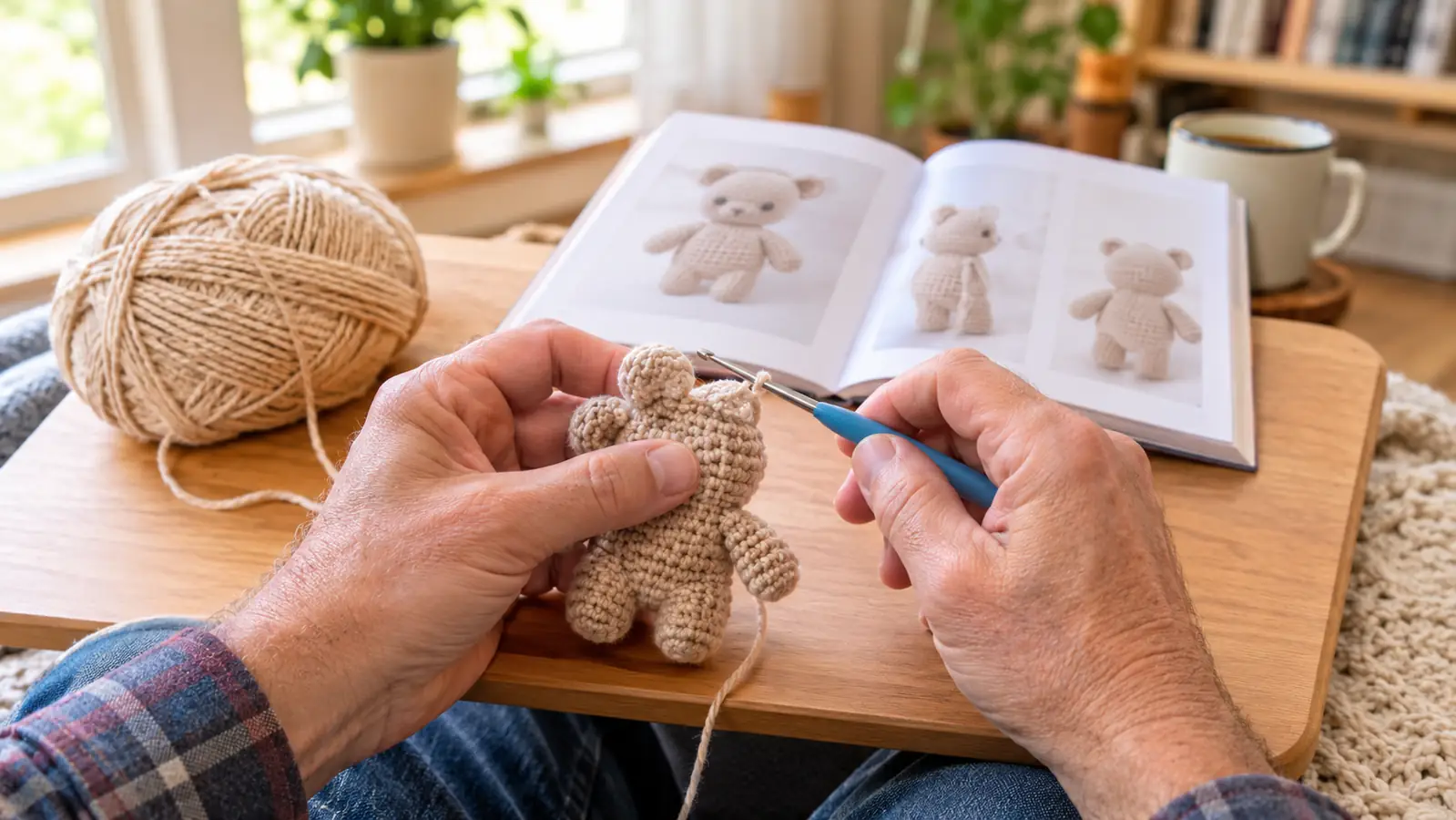
I wish someone had told me that the first critter is allowed to be ugly. Mine has one ear higher than the other, a belly that is not quite round, and a face I embroidered twice because the first one looked surprised. My granddaughter loves him anyway. The second critter was neater. The third one looked like the picture. It is a skill, and skills take practice.
I also wish someone had told me to buy a zippered project bag before I started, not after Pickles made off with a yarn tail at midnight. And I wish I had known that frogging, which is just ripping out stitches, is not a moral failure. Every crocheter I know has taken out more stitches than they have kept. The ones who finish critters are the ones who are willing to start a round over.
What Else Helps
A few things made my first critter easier. A stitch marker, or a scrap of contrasting yarn tied into the first stitch of each round. A zippered project bag, because Pickles will find any open basket. A floor lamp that actually points at your work, because counting stitches in bad light is how you end up with 29 stitches in a 30-stitch round.
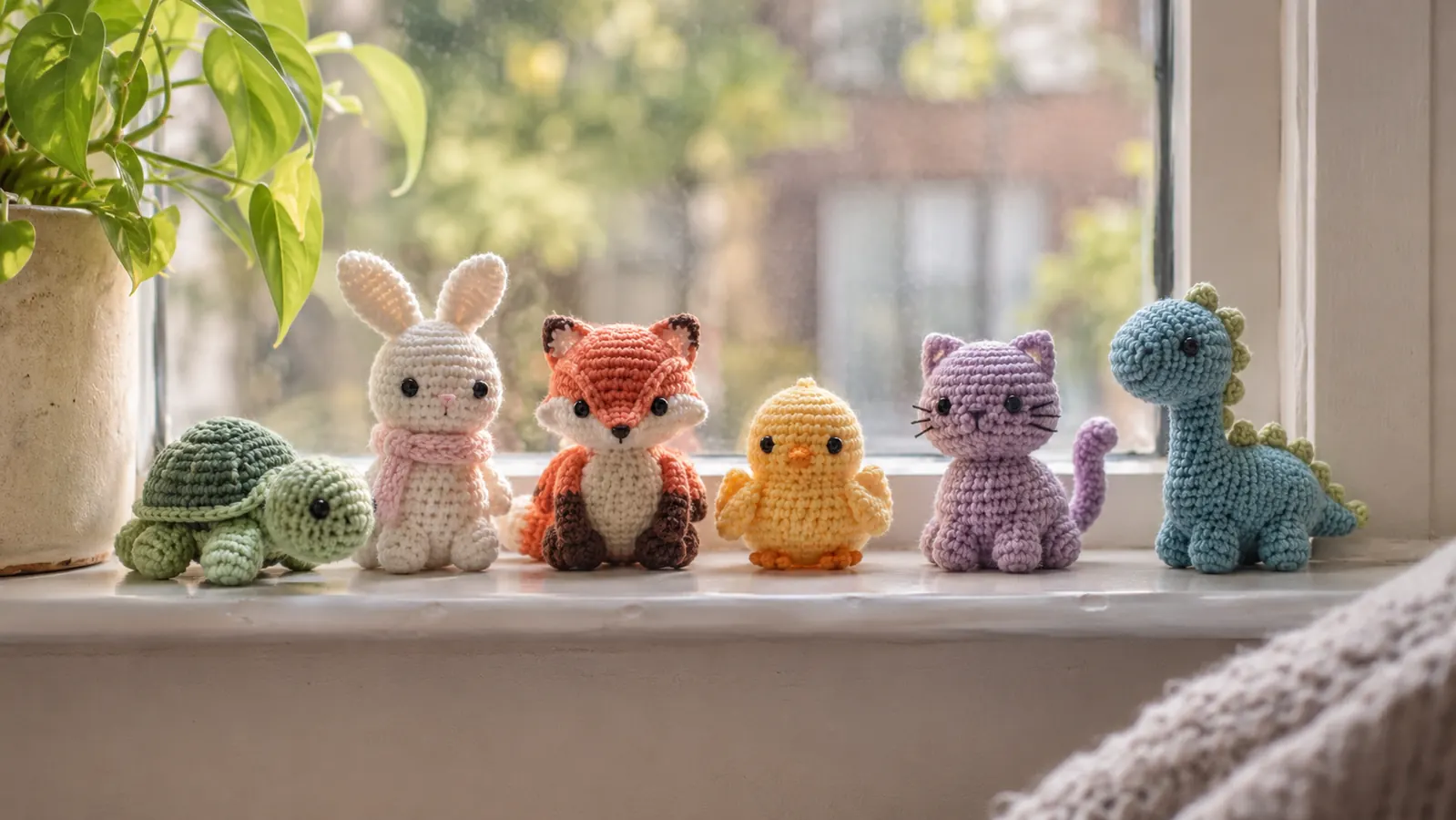
And a book you trust. Amigurumi Friends is the pattern book that stayed open on the arm of my recliner, and it is the one I reach for when a grandchild asks for a specific animal. At 4.7 stars across 824 reviews, I am clearly not the only one who feels that way. It is forgiving, the finished critters look like the pictures, and the way it ties shapes, colors, details, and yarns together means one pattern can become a dozen different animals.
If you are buying this book for a beginner, do not hand it over with a tiny steel hook. Hand over a comfortable hook in a middle size, a soft worsted yarn in a light color, and a stitch marker. Light yarn shows your stitches clearly, which matters more than the color matching the pattern. The book will handle the rest.
Four evenings, one frogged ear, and a cat who stole the yarn tail, and I had a critter my granddaughter refuses to put down.
Your first critter is closer than you think
Amigurumi Friends has been on my side table for months, and it is still the book I reach for. 20 easy patterns, 144 pages, and a method that turns one pattern into more than 100 critters. Start with the simplest pattern and let the book do the explaining.
Amazon Check Today's Price on Amazon →